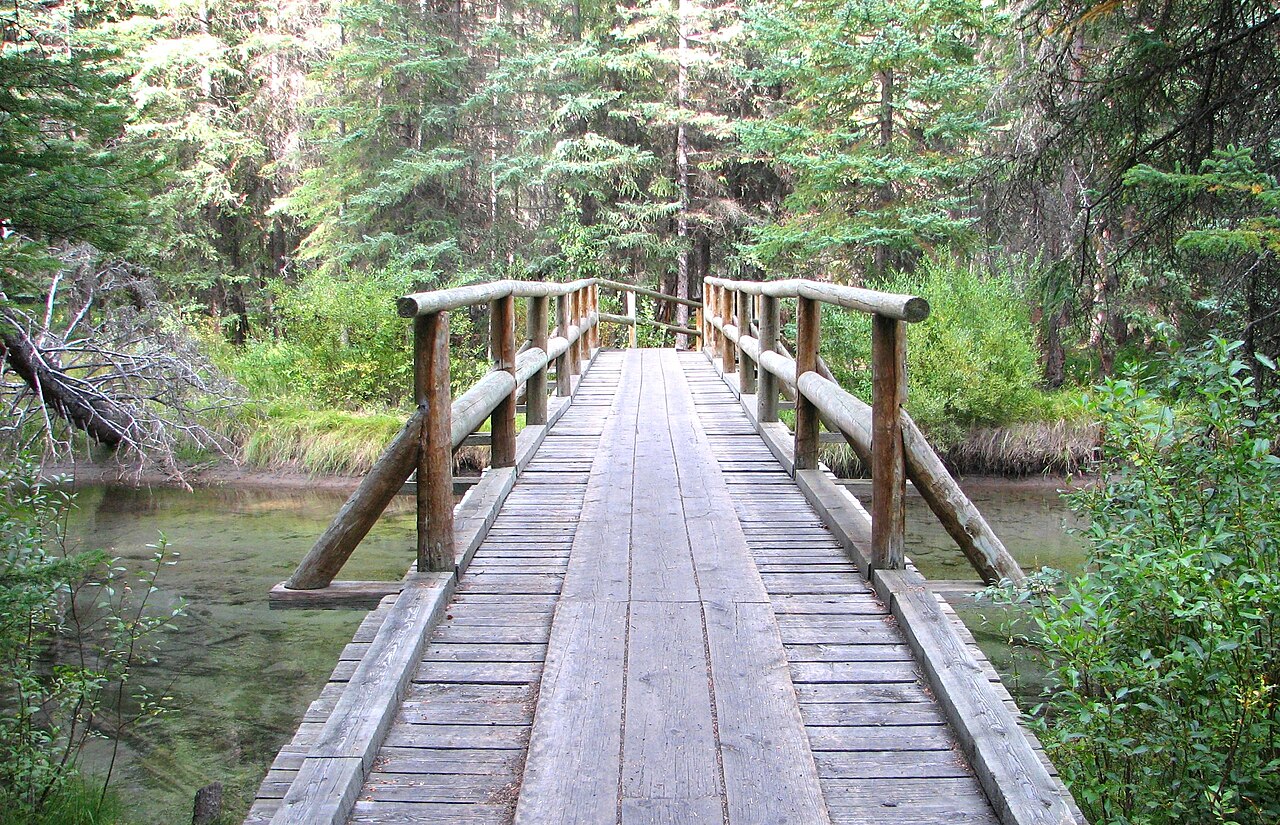

Choose the forest as the attraction
Fenland is a useful Banff choice when the interest is close-up woodland rather than a major mountain panorama. The short circuit passes through an old-growth spruce setting, offering a different scale of experience from the high viewpoints and lake basins that dominate a first-visit wish list. Choose it because that contrast appeals. If your main aim is to look down over Banff, Tunnel Mountain answers a different question and is a better route to investigate.
A forest walk can be a complete activity without a distant landmark at its end. Look at the layered canopy, trunks, water-adjacent setting and smaller changes in the path's surroundings. This is a route for slowing observation rather than measuring progress towards a summit. A short loop is particularly effective when the purpose is to spend time outdoors while leaving the rest of the day relaxed.
The root patches matter more than the small number
The official description identifies significant roots despite the modest loop and limited climbing. That is the practical detail to retain. Low elevation gain does not guarantee a smooth surface, and a broad easy category cannot establish how the route fits an individual access requirement. If roots or uneven ground are important to your choice, consult the detailed current trail information instead of relying on the headline length.
This is also why Fenland should not be described as a universally simple recovery walk. Someone seeking less climbing may enjoy it, while someone specifically needing a more uniform surface may prefer an independently assessed alternative. The right comparison depends on what made the preceding day demanding. A lower-effort choice should remove the kind of effort you want to reduce, not merely have a shorter name or smaller total distance.
Downtown access changes the walking total
Fenland's official loop is 1.9 kilometres with 20 metres of gain and a 40-minute estimate. Parks Canada also identifies an approximately 1.5-kilometre walk from downtown to the trailhead. Using that approach in both directions produces about 4.9 kilometres for the downtown-plus-loop outing, before any additional riverside wandering. This is why the forest can be a short circuit without your whole on-foot day being equally short. Choose a trailhead-start visit if limiting total walking is important; choose the connected town outing if that extra approach is welcome. The modest gain does not remove the significant roots on the loop.
If the forest is your main activity, keep the approach purposeful and the remainder modest. If you are combining Fenland with other town-area walking, avoid attaching every available loop simply because each looks short. Small routes accumulate distance and stop time. A coherent day with a woodland circuit and a relaxed river section is often more enjoyable than a sequence whose only logic is that all the names fit near Banff.
Fenland, Marsh or Tunnel?
Choose Fenland to add texture and quiet observation to a visit dominated by big views. Choose Tunnel when the high perspective itself is the goal. Choose a river or wetland route because you want those environments, not because they are interchangeable items under a general easy-walk heading. Each supplies a different way of understanding the valley.
Swipe the table horizontally to compare every column.
| Choice | Main experience | Decision factor |
|---|---|---|
| Fenland | Old-growth woodland on a short circuit | Roots and the complete town approach |
| Marsh-area walking | Wetland and waterfowl interest | Different ground and the selected route scope |
| Tunnel Mountain | A summit perspective above the town | A meaningful uphill climb rather than a forest loop |
| Bow River paths | A river-level relationship with Banff | The specific surfaces and distance selected |
A loop does not need a preferred photography direction
Because the route is a compact circuit, the most useful directional choice is the one that fits current signs and local information. There is no reason to invent a universally superior clockwise direction for the sake of a guide. The forest's detail changes with light and conditions, and a rigid promise about photography would add false precision. Allow the authorised path and your pace to create the experience.
Stop where the path permits others to pass without stepping onto sensitive vegetation. A close-up photograph of forest texture does not require moving off the trail. The same restraint is important around wildlife: observing from an appropriate distance is part of the outing, while trying to obtain a closer image changes the relationship in an unhelpful way.
Use it to create a genuinely lighter day
Fenland works particularly well when you deliberately want less elevation after a climbing day. Keep the rest of that day equally intentional. A short forest loop followed by an unrestricted list of town walks can quietly become another endurance day. Decide which additional experience you most want, if any, and leave time for an ordinary meal and rest. The point is a contrasting pace, not merely a different place to keep walking.
For a mixed group, the loop format provides a clearly shared activity. Agree how much of the approach you are including and whether everyone is comfortable with the rooty path. If detailed surface needs differ, resolve them before setting out. A common route is more enjoyable when the least comfortable walker is not learning about the ground after the group has already committed to it.
Check conditions, retain the clear purpose
Current official reports still matter on a short outing. Mud, ice, fallen material or wildlife notices can affect the choice, and the nearby town does not remove outdoor variability. This article does not claim that a shaded forest is a universal answer to poor weather. Choose it only when the actual route and conditions fit the party.
The lasting reason to put Fenland into a first Banff stay is the contrast it supplies. A high viewpoint shows the valley's form; this circuit reveals a smaller landscape within it. With the approach counted and the roots understood, the short loop can be selected honestly for what it is: a forest experience, rather than a thin substitute for a mountain day.
Questions answered
Is Fenland smooth because it has little climbing?
No. Parks Canada identifies significant root patches. Assess the surface separately from elevation gain.
Does the circuit length include walking from Banff?
The named loop statistic is not your accommodation-to-accommodation total. Add the chosen approach and return.
Sources & scope
Route facts are drawn from the resources below. The comparisons and recommendations are our research-based editorial analysis; this is not a claim of personal trail inspection. Access and conditions must be checked with the responsible land manager before travel.
- Parks Canada: Fenland detailed surface and approach information
- Official tourism: easy walking alternatives
Editorial standards · Explore the destination guides
Found a detail that needs correcting? Send the guide URL and a supporting source so we can review the exact route version.