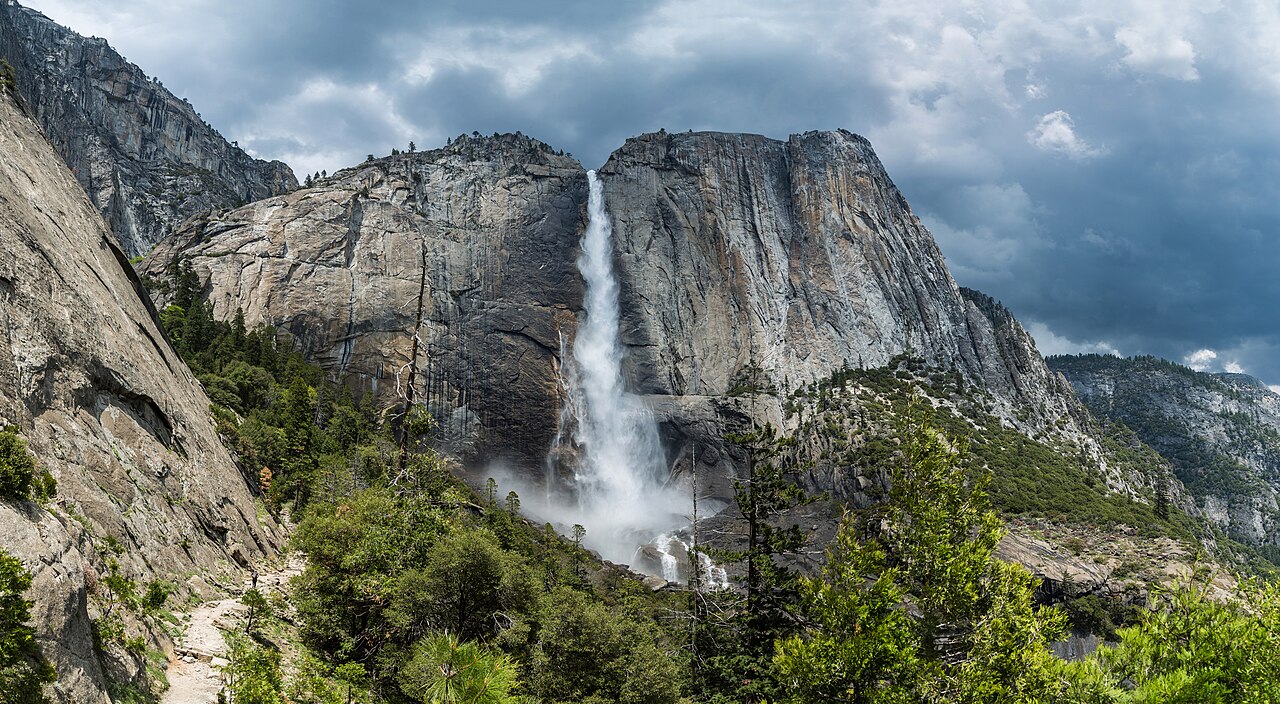

- Columbia Rock
- 2 miles return; approximately 1,000 feet gain
- Top of falls
- 7.2 miles return; approximately 2,700 feet gain
- Start
- Camp 4 area, Yosemite Valley
Start with the correct Yosemite Falls trail
The Upper Yosemite Fall outing begins near Camp 4 and climbs away from the valley floor. It is entirely different from the short paved loop at Lower Yosemite Fall. The shared waterfall name is the source of many unrealistic expectations: a visitor may picture a modest walk to a viewing platform while reading a description of a major ascent. Mark the Camp 4 starting area and the top-of-falls destination on the official map before comparing this route with anything else.
Choose the full hike if the climbing journey is part of what you want from Yosemite. A close view of water alone is not a reason to accept a long uphill and downhill day. The landscape changes as the valley floor becomes a distant pattern, and that change is the real attraction of the route. If the group simply wants to encounter Yosemite Falls from an established short trail, the lower loop solves that problem more directly.
Two destinations, two commitments
The NPS distinguishes Columbia Rock from the top-of-falls destination. Columbia Rock is a two-mile return with about a thousand feet of gain, while the top-of-falls outing is listed at 7.2 miles return with about 2,700 feet of gain. These figures make the comparison concrete: the shorter objective is not level, and the longer one adds a great deal beyond it. They should be selected as separate plans, not merged into a vague promise to see how far everyone feels like going.
Columbia Rock makes sense when the group wants an uphill valley viewpoint but does not want the complete top-of-falls day. Choose the full ascent when everybody wants the sustained climb, has a comparable recent experience, and understands the return. The key recommendation is to choose before starting. A shorter objective feels more satisfying when it is the destination everyone expected, instead of a place where one person begins lobbying the rest to continue.
The ascent changes your relationship with the valley
The lower trail rises through repeated switchbacks. The practical effect is that altitude accumulates early rather than arriving only near the final destination. Views toward the valley create useful pauses, but they do not turn the climb into a sequence of effortless strolls. Pay attention to how the group is moving on this opening stage: the eventual descent will retrace demanding ground after more walking, and the complete day should remain comfortable rather than merely possible.
Above the lower viewpoint, the route continues toward the waterfall landscape and then the upper destination. Do not assume a temporary downhill section means the hard part is finished. A mountain route can lose and regain height while remaining an overall ascent. Compare progress with the whole profile rather than with how high the waterfall appears. The useful mental picture is a sustained mountain walk with intermediate views, not a straight staircase whose next landing must be the top.
Plan the descent as an activity, not a remainder
On an out-and-back, reaching the named destination leaves the return still to do. The descent asks for attention on the same steep and rocky route that required effort uphill. Some walkers find that prolonged descending is the part they enjoy least. Ask about that preference before choosing the hike; somebody can be strong on climbs and still dislike a long return over uneven slopes. The correct plan matches both halves of the day to the group.
Avoid adding Yosemite Point, Eagle Peak, or another rim objective to the basic outing just because a sign offers the possibility. Those extensions require a separately assessed route and more return time. The top-of-falls destination is a complete goal. A practical rule is to keep the first visit bounded by the route you researched and leave additional rim walking for another day. This prevents the feeling of having arrived from quietly expanding a day that is already substantial.
What to compare with Four Mile Trail
For the same-trail return, Upper Yosemite Fall is listed at 7.2 miles and 2,700 feet of gain; Four Mile Trail to Glacier Point is 9.6 miles and about 3,200 feet. The latter therefore asks for more walking and climbing, while emphasising changing valley panoramas rather than approaching Yosemite Falls itself. Choose Upper Yosemite Fall when the waterfall landscape is the central interest and the smaller of these two substantial profiles fits. Choose Four Mile when the panorama-led journey to Glacier Point justifies its larger return. Neither is a short alternative to the other, and road access at Glacier Point is irrelevant unless your return transport is already arranged.
For a first long Yosemite hike, choose one of these routes, not both in a short stay simply to tick off the best-known climbs. A gentler valley-floor outing between ambitious days may offer more variety. Cook's Meadow also gives context for looking back toward the high ground you visited. That contrast creates a coherent trip: first the view from below, then a chosen ascent, then time to appreciate how the perspectives connect.
Keep the waterfall endpoint within its boundaries
The official route includes designated walking and viewing areas. Follow them and respect railings and posted directions. Reaching the top of a waterfall does not create a swimming, wading, or river-edge exploration opportunity. The view should be taken from the places provided for it, and a photograph should not redefine the endpoint as a more exposed location beyond the trail. The route is impressive without making the final stop a separate risk-taking activity.
Season and weather affect both the appearance of the falls and the walking conditions. This article does not promise water volume or year-round suitability. Consult the dedicated NPS route information and current guidance before the outing. If those checks rule out your planned day, select a separately researched alternative instead of treating a smaller part of the same ascent as automatically appropriate. The choice must be based on the actual route and circumstances, not the desire to preserve a particular trail name.
Questions answered
Does the Upper Yosemite Fall Trail start on the Lower Fall loop?
No. The climbing trail starts near the Camp 4 area. The lower paved waterfall loop is a separate outing.
Is Columbia Rock a reasonable destination by itself?
Yes. It is an established shorter uphill objective with its own valley view. Plan it as a complete outing rather than as an obligation to continue to the falls.
Can I extend to another rim viewpoint?
Additional rim routes should be separately researched and included in a complete return plan. The top-of-falls hike already provides a substantial day without extensions.
Sources & scope
Route facts are drawn from the resources below. The comparisons and recommendations are our research-based editorial analysis; this is not a claim of personal trail inspection. Access and conditions must be checked with the responsible land manager before travel.
Editorial standards · Explore the destination guides
Found a detail that needs correcting? Send the guide URL and a supporting source so we can review the exact route version.