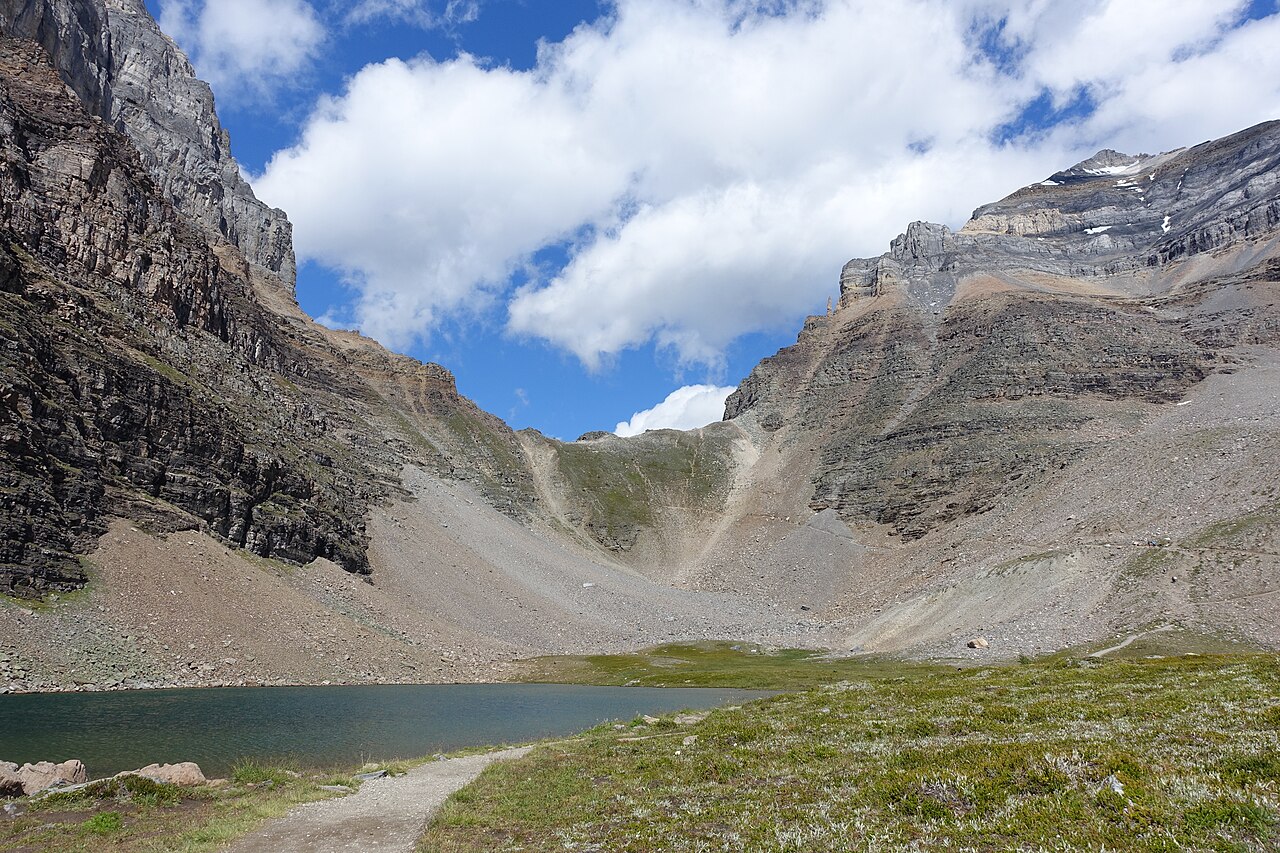

Name the whole route before judging the pass
The route considered here starts at Moraine Lake, climbs through Larch Valley, reaches Sentinel Pass and returns to Moraine by the same planned approach. The words via Larch Valley matter. An approach from Paradise Valley is a different and longer undertaking, while crossing the pass and continuing down the other side creates a point-to-point journey with another finish. They cannot share one set of casual distance or time expectations.
Sentinel is an appropriate objective only when the higher pass is itself the desired reward and its terrain fits the party. If the main attraction is the larch landscape, make Larch Valley the destination. That is a complete outing. The visibility of the pass above the basin can make the continuation seem inevitable, but a landscape feature in view is not an instruction to climb it.
Why the final ascent changes the day
The pass follows the larger approach from Moraine rather than beginning at the top of it. By the time you assess the upper ground, you have already spent meaningful energy reaching the valley. The steeper switchback section is therefore a commitment added to accumulated effort, not an isolated short hike. Decide at the planning stage whether you want that complete outing. Do not make a tired group negotiate the question under the influence of seeing other people continue.
Descent is part of the same decision. The ground crossed uphill remains on the return, and looking down a steeper slope can feel different from approaching it. A walker who is comfortable in forest may have different preferences on higher open terrain. This guide offers no technique for negotiating ground beyond your experience. Seek appropriately qualified local assessment where needed rather than assuming popularity resolves the question.
Pass, valley or Eiffel: a meaningful comparison
For a first substantial Moraine hike, Larch Valley offers a simpler destination if your interest is trees and mountain setting. Choose Sentinel because you want the high divide and have assessed the full route. Choose Eiffel because its lateral valley perspective interests you. This is a better comparison than ranking the three solely by how dramatic their photographs look.
Swipe the table horizontally to compare every column.
| Choice | Its distinctive reward | What you avoid or add |
|---|---|---|
| Larch Valley | Larch country and an alpine basin | Avoids making the higher pass the objective |
| Sentinel via Larch Valley | A high divide between two valley settings | Adds upper steep ground and its descent |
| Eiffel Lake | A different valley-side lake perspective | Uses another branch instead of the pass approach |
The other side is not the return by default
The pass's position between Larch Valley and Paradise Valley creates a tempting visual assumption: going down the far side must be a convenient way home. That is incorrect for an out-and-back plan to Moraine Lake. The far side belongs to another route, and Parks Canada's Paradise-side description explicitly identifies rocky slopes requiring route finding. Do not convert the day into that journey because it appears to avoid retracing steps.
A researched traverse would require its own complete map, capability assessment and verified finish arrangements. A connector is not a shortcut merely because it descends. For this guide's route, return towards the basin and the Moraine approach you selected. The clear finish is one of the benefits of the out-and-back format, even when the same landscape appears twice.
Keep adjacent mountain objectives outside this hike
Sentinel Pass appears in the context of other mountain routes, including objectives that are not ordinary day hiking. A nearby summit label does not mean the selected walking trail should naturally continue there. Do not improvise an ascent or follow another party off your planned line. The pass is the endpoint of this outing, not a staging area for adding an unresearched mountain because you still have daylight.
The same restraint applies to photography. Stay in appropriate established areas rather than treating an edge or rocky spur as a required camera position. The value of reaching the pass is understanding the meeting of the valley landscapes. That experience does not depend on standing in the most dramatic possible foreground.
Build a day with enough return margin
Give Sentinel the principal walking allocation, with a flexible evening afterwards. The total day includes reaching Moraine, the approach, time in Larch Valley, the higher section, and the complete return. Access arrangements are separate from trail effort and need direct verification. Do not rely on the shortest time quoted for a neighbouring hike to make a fixed transport window look feasible.
Consult current Parks Canada reports for snow, weather and restrictions before choosing the route. Higher ground may differ substantially from conditions at the lake. No date in this article guarantees suitability. If the upper section is a poor match, the correct response may be the independently assessed valley plan rather than an attempt to salvage a pass photograph. The lasting recommendation is to choose the complete Sentinel outing deliberately and keep its endpoint and return explicit.
The Moraine-side Sentinel listing is 5.6 kilometres one way, with 750 metres of ascent and 50 metres of descent, and a 4.5-to-5.5-hour return estimate. Compare that with the directory's Larch Valley/Minnestimma line: 4.5 kilometres one way and 570 metres of ascent. The pass choice therefore adds a higher objective after an already substantial approach; it is not included in the valley's walking allowance. Use these figures for the specified Moraine-side route only. Paradise Valley has a different approach and cannot inherit this total. If the valley experience satisfies the party, the smaller itinerary is already a complete mountain day.
Questions answered
Do I have to cross into Paradise Valley?
No. The outing described here returns through Larch Valley to Moraine Lake. Crossing the pass creates a different journey that needs its own full planning.
Can I stop at Larch Valley instead?
Yes, when that separately assessed outing matches the conditions and your group. The valley is a worthwhile destination in its own right.
Sources & scope
Route facts are drawn from the resources below. The comparisons and recommendations are our research-based editorial analysis; this is not a claim of personal trail inspection. Access and conditions must be checked with the responsible land manager before travel.
- Parks Canada: Sentinel routes and Paradise-side terrain distinction
- Official tourism: Moraine-area route alternatives
Editorial standards · Explore the destination guides
Found a detail that needs correcting? Send the guide URL and a supporting source so we can review the exact route version.