
Choose the valley rather than another lake
Plain of Six Glaciers is the Lake Louise choice for a walker interested in following the valley deeper into its mountain setting. Lake Agnes takes you uphill through forest towards a second lake. Plain of Six Glaciers continues the story suggested by the far end of Louise: water gives way to the terrain and mountain scenery beyond. Neither is an upgraded version of the other. They organise the day around different landscapes.
If the question is which tea house to visit, reframe it as which walking route you want. A building is a useful named destination, but food availability should not be the foundation of a mountain-day plan. Carry the supplies your outing requires and verify specific services directly if you intend to use them. The route should remain worthwhile when the reward is simply the setting and a self-sufficient pause.
The lakeshore beginning can distort your expectations
The early shore section can make this outing seem like an indefinite continuation of an easy lake visit. It is better understood as the approach to a different hiking experience. Once the water-level portion is behind you, the route's relationship with the valley changes. Do not judge the complete day by the terrain beside the public waterfront, and do not begin the longer walk merely because the first section felt comfortable.
The useful decision belongs before the start: either plan the lakeshore as an out-and-back in its own right or plan the mountain-valley route with its full return. A visitor who set out for a short stroll may be poorly placed to turn it into a substantially longer outing. Conversely, a prepared walker choosing Plain of Six Glaciers can enjoy the gentle beginning as one phase rather than expecting the whole route to feel like the same path.
Glacier views do not imply glacier access
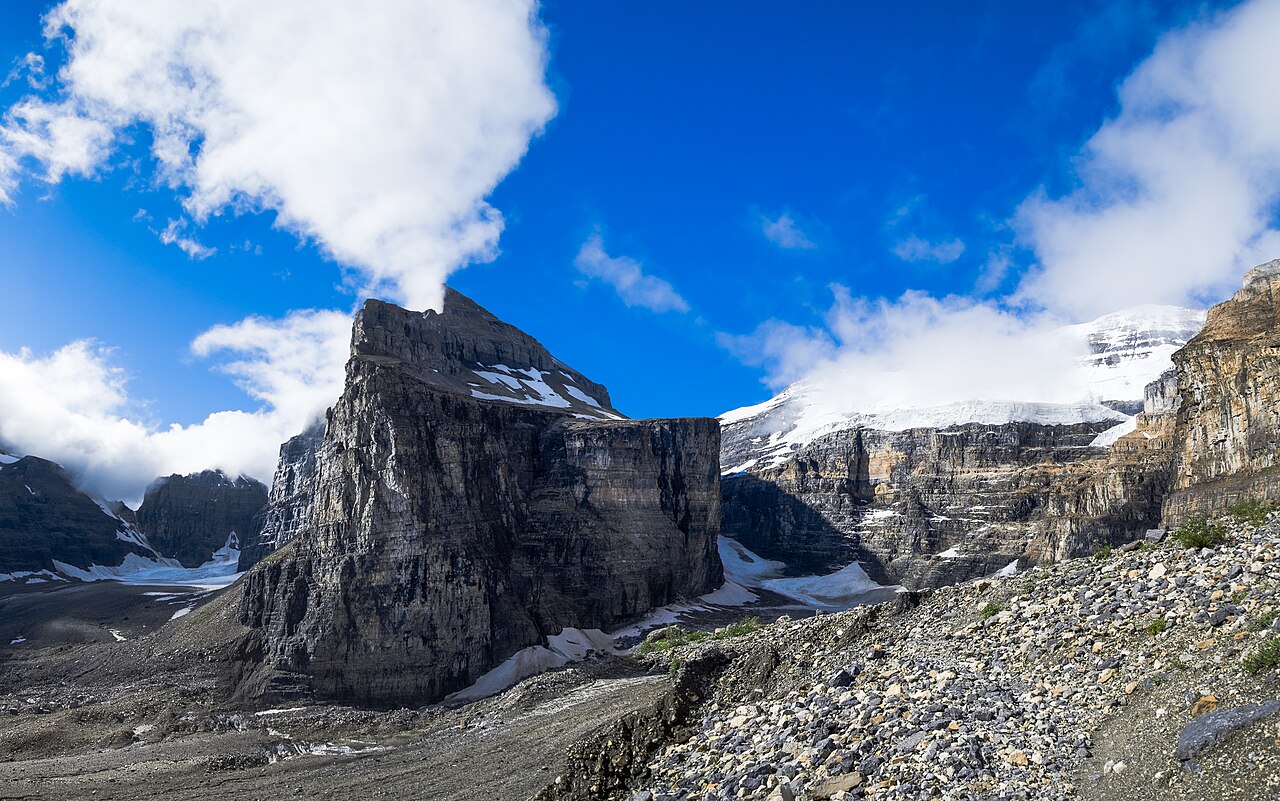
The route name refers to the surrounding mountain landscape. It should not be interpreted as an invitation to leave the established trail, approach ice or find a way onto a glacier. The walking objective is the designated route and its appropriate viewpoints. Ice, debris and rock are not interchangeable surfaces simply because they share a photograph. This article provides no glacier-travel instructions and recommends no such extension.
The strongest observation is often about scale and connection: how the valley broadens or narrows, how rock surrounds the glacial features, and how far the lake now feels behind you. Those are experiences available from the walking route. An urge to get physically closer can erase the distinction between enjoying a view and changing the activity. Keep that boundary clear when interpreting images or deciding where to pause.
Plain of Six Glaciers or Lake Agnes?
For a first visit, choose the experience you most want rather than combining two routes to avoid making a decision. If you have two walking days around Louise, doing the valley outing on one and the Agnes-side outing on another gives each a distinct purpose. It also leaves you with a clearer memory of the contrast than a long day in which both are rushed.
Swipe the table horizontally to compare every column.
| Priority | Better route to investigate | Tradeoff |
|---|---|---|
| A second lake after a forest climb | Lake Agnes | Less emphasis on following the long valley beyond Louise |
| The landscape beyond the head of Louise | Plain of Six Glaciers | A larger commitment than the lakeshore stroll |
| A higher overhead viewpoint | A separately researched Beehive route | Additional climb and descent beyond the Agnes approach |
| A controlled gentle outing | Lake Louise Lakeshore | No need to continue into the mountain valley |
A combined tea-house route is a separate itinerary
The existence of connecting paths does not make the Agnes and Plain of Six Glaciers combination equivalent to either out-and-back. The full line contains its own junction decisions, additional effort and return shape. Research the actual combined route if you want it. Do not take one article's distance, another article's duration and an app's loop line and assume they describe a coherent plan.
Connections can appeal because they avoid retracing ground, but retracing can be useful. The valley looks different as you return towards the lake, and a known approach simplifies the shape of the day. A longer loop is not automatically a better value. Choose it only when the connecting landscape and additional walking are part of the desired experience, not because repeating any section feels like a failure.
Allow room for the journey back to the waterfront
The named destination creates a natural pause, but reaching it is not the end of the outing. Keep the return distance and terrain visible in your notes. A scenic stop can make the day longer without adding a single metre to the published route. Give photography, food and ordinary group pauses an honest allowance so that you are not trying to recover time later. The trail's purpose is to spend time in the valley, not merely touch a landmark.
If your travel arrangements impose a fixed return window, select a conservative walking plan that fits it. Avoid depending on an optimistic pace estimate or assuming every section will take the same time in reverse. Separate the actual hike from access to Lake Louise; neither part should disappear from the schedule because a guide begins at the waterfront.
Use official information to define the outing you will do
For the directory's Plain of Six Glaciers itinerary, Parks Canada lists 5.9 kilometres one way, 595 metres of ascent and 250 metres of descent, with a four-hour return estimate. That is 11.8 kilometres of trail when the same line is retraced, before any extra viewpoint or connection you independently select. The loss recorded on the outward journey is particularly relevant: returning is not simply one uninterrupted descent. Use that profile to reserve a principal walking day, then add pauses and the separate Lake Louise access arrangements. A different endpoint or the Agnes connection needs its own figures rather than inheriting this total.
Check the current report for snow, wildlife notices and other restrictions before setting out. This guide does not promise a season opening or stable year-round access. Its recommendation is specific: choose Plain of Six Glaciers when the valley journey is the attraction, keep to the established walking route, and leave glacier travel and unassessed connections outside the plan.
Questions answered
Does this hike take me onto a glacier?
No glacier travel is part of this guide. Stay on the designated walking route and enjoy the surrounding glacial landscape from appropriate viewpoints.
Should I always combine it with Lake Agnes?
No. The connection produces a different and larger outing. Two separate walking days can offer a clearer contrast between the valley landscape and the Agnes-side climb.
Sources & scope
Route facts are drawn from the resources below. The comparisons and recommendations are our research-based editorial analysis; this is not a claim of personal trail inspection. Access and conditions must be checked with the responsible land manager before travel.
- Banff and Lake Louise Tourism: Plain of Six Glaciers route context
- Parks Canada: current Banff hiking directory and reports
Editorial standards · Explore the destination guides
Found a detail that needs correcting? Send the guide URL and a supporting source so we can review the exact route version.