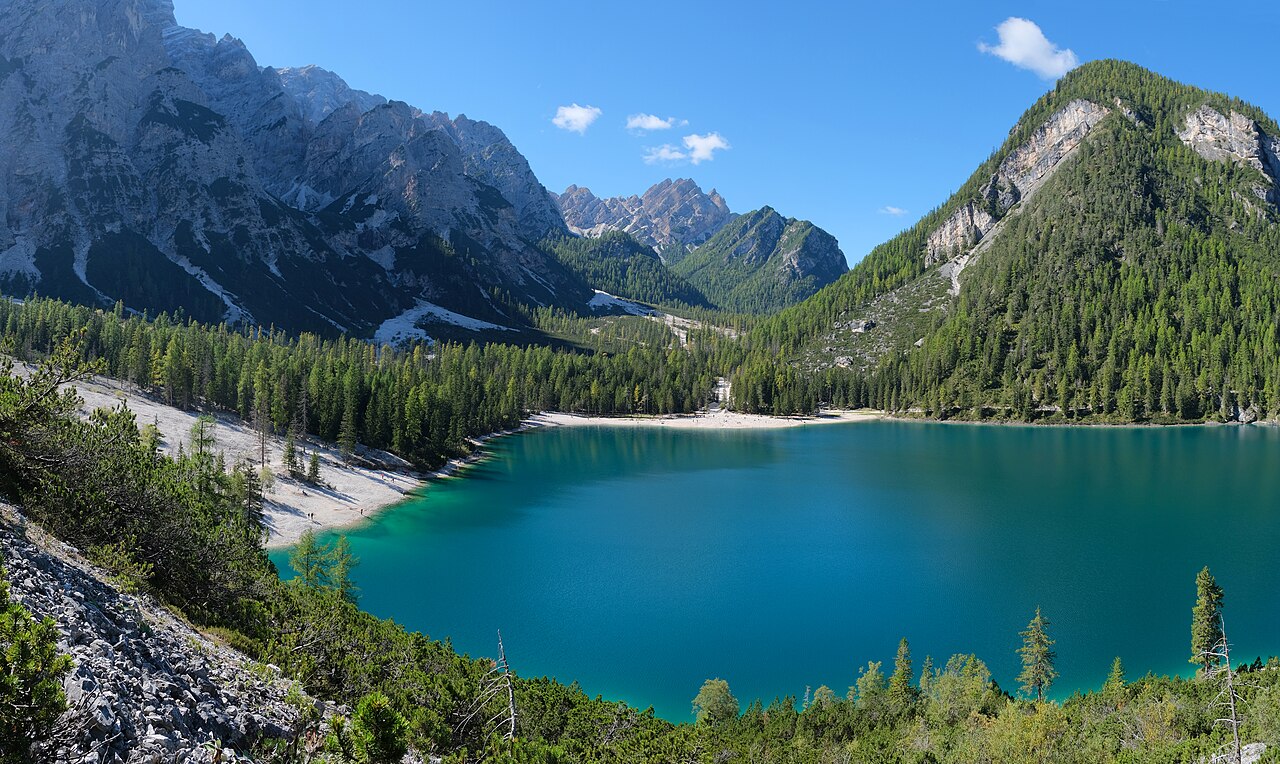

The mistake hidden in the famous arrival view
The familiar image of Lago di Braies shows water, mountains and the boathouse near the main arrival area. It says little about the complete circular walk. The official Braies tourism information distinguishes a broad forest path on one side from a narrower path with rises and steps on the other. That difference should determine your route choice. A comfortable first few minutes beside the water cannot establish whether the entire shore circuit matches your walking preferences.
For a visitor who wants an unhurried lakeside experience, the best question is not how quickly the loop can be completed. Ask whether you want a full succession of views or a shorter return walk on the terrain you find comfortable. Both are legitimate visits. The circuit adds changing shorelines and a different relationship with the mountains; the partial walk gives you more control over effort and the point at which you turn back.
Understand the shores before choosing a direction
From the northern arrival end, the western shore is the broader, flatter option; the eastern shore has the narrower path and steps. Facing south across the lake, that places the western shore on your right. For a controlled partial visit, follow the designated western path and return the same way instead of committing to the eastern side. For a complete circuit, South Tyrol tourism describes approximately 3.5 kilometres, with both shore types included. Starting on the eastern side brings its steps earlier; reversing direction simply moves them later. Neither direction converts the full circuit into a uniformly flat walk.
If you want to judge the more demanding shore early, choose a direction that reaches it before you are tired. If you mainly want a gentle taste of the lake, use the broader side as an out-and-back and reverse before terrain exceeds your comfort. This is a better plan than trying to force a loop because an app displays a neat circle. Confirm the specific access and surfaces you need with local information if mobility requirements are central to the visit.
Why the far end changes the experience
Walking away from the boathouse moves the lake from an iconic composition into a larger landscape. Near the northern end, you look towards the mountains across the full length of water. Elsewhere, the shore itself, overhanging trees and the changing angle to the cliffs become more prominent. At the opposite end, turning back towards the arrival area produces a different sense of scale. You are no longer simply approaching the same picture from farther away.
For photography, this means the circuit can be worthwhile without seeking an unofficial access point. The designated lakeside path already offers successive angles. Reflections depend on light, breeze and water conditions; none is guaranteed by walking at a particular hour. Do not cross protective boundaries, enter sensitive shore areas or compete for a position beside the water merely because an online image conceals where its photographer stood.
Steps, wet surfaces and walking pace
The stepped sections matter most for people who prefer smooth ground, dislike repeated changes in height, or are walking with companions whose pace differs. They can also create a stop-start rhythm when people pass in opposite directions. Build the outing around the slowest comfortable movement, including pauses. Calling the circuit short does not describe how its narrower parts will feel to a particular group.
A route time should include the activity you actually intend: walking, looking, taking photographs and choosing places to pause without obstructing the path. If the purpose is a restorative lake walk, leave enough room to enjoy it. Pushing through the more uneven shore to catch up with a compressed schedule defeats that purpose. Conversely, a walker who enjoys variety may find that the steps and changing banks make the complete circuit more interesting than the arrival promenade alone.
Three sensible ways to visit on foot
Choose the full circuit for its variety, not because it is the default product of arriving at Braies. A partial walk can fit neatly into a day that includes another gentle outing, while a complete circuit deserves its own unhurried window. There is no useful score for doing the loop when the chosen terrain makes the day less enjoyable.
Swipe the table horizontally to compare every column.
| Walking plan | Best fit | Main limitation |
|---|---|---|
| Short arrival-area stroll | A first look with very limited walking ambition | Little sense of the lake beyond its most photographed end |
| Broad-shore out-and-back | A controlled turn-back plan on more uniform ground | Does not include the full sequence of shore views |
| Complete circuit | Walkers who want both shores and accept steps | Requires the whole mixture of surfaces and gradients |
A lake walk is not a mountain extension
Routes leaving the lake basin for higher ground belong to a different plan. An attractive sign or a path disappearing uphill should not turn the shoreline circuit into an improvised mountain day. The Fanes-Sennes-Braies setting creates many possibilities, but the scope here is the established lake circuit. Keep your map focused on returning to the northern starting end rather than interpreting every junction as part of the loop.
This distinction also keeps your packing and pacing honest. A planned circuit may fit a gentle sightseeing day; an ascent above the lake changes the effort and requirements. If a higher walk interests you, research it separately, with its own route description, terrain assessment and return. The visual closeness of a mountain does not indicate how easily its viewpoint can be reached.
What to check without turning this into a live guide
Use Braies tourism's current visitor information for arrival arrangements and any local restrictions. This page does not reproduce road windows, parking prices or facility hours. The stable decision is whether you want the whole shore circuit and its steps. The variable decision is whether conditions on your visit make that chosen version appropriate. A past summer photograph cannot answer the latter.
Protective rules are part of the experience rather than an obstacle to getting closer. Keep to the indicated paths, give other walkers passing space and take your litter with you. The lake is within a protected natural setting, not a photography set. A visit that respects those boundaries can still provide a rich sequence of views simply by using the authorised shore path and allowing time to look.
Questions answered
Is the entire Lago di Braies circuit flat?
No. Official visitor information describes a broad forest path on one side and a narrower path with uphill sections and steps on the other. Assess the full circuit rather than judging it by the arrival area.
Can I turn back instead of completing the loop?
Yes, a planned out-and-back can be a better choice if you want to control the amount and character of walking. Use the designated path and return before ground becomes unsuitable for your group.
Sources & scope
Route facts are drawn from the resources below. The comparisons and recommendations are our research-based editorial analysis; this is not a claim of personal trail inspection. Access and conditions must be checked with the responsible land manager before travel.
- Braies tourism: lake visitor information and shore-path description
- South Tyrol tourism: Lake Braies shores and circular walk
Editorial standards · Explore the destination guides
Found a detail that needs correcting? Send the guide URL and a supporting source so we can review the exact route version.