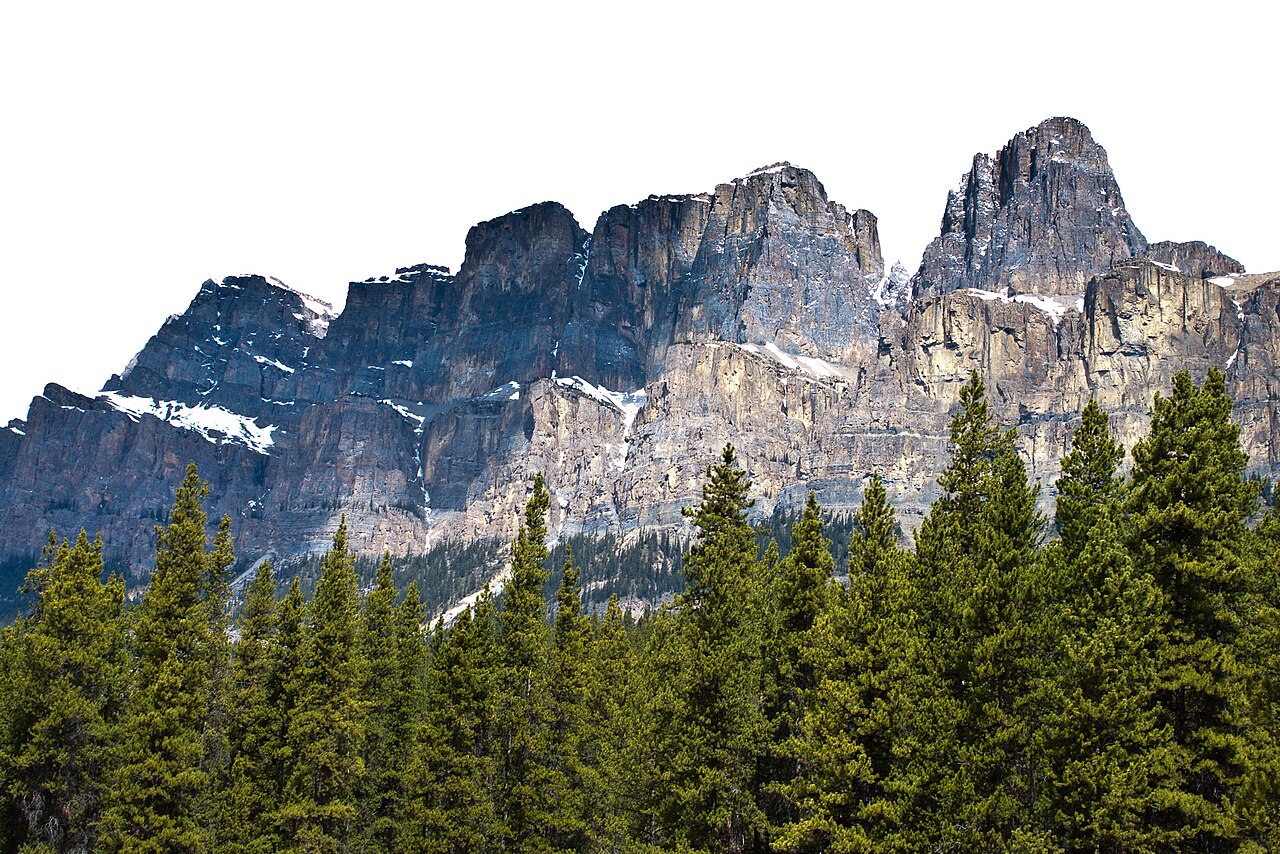

A lookout site beneath the mountain, not its summit
Castle Lookout is the destination to choose when you want a higher perspective over the middle Bow Valley. Its name refers to a former fire-lookout site beneath Castle Mountain's cliffs. It is not a hiking route to the mountain summit. Keep that distinction in every map search and saved note. A photograph of Castle Mountain from the road and an account of the lookout hike can describe the same general landmark while referring to entirely different activities.
The lookout tower itself has been removed. The historical purpose remains useful for understanding the location: it was selected for seeing across a broad landscape. If you arrive expecting an intact tower to explore, you have chosen the wrong reason for the walk. The reward is the valley panorama and the experience of gaining height beneath the mountain setting.
A scenic-road location does not make it a pullout
The trail begins off the Bow Valley Parkway west of Castle Junction. That geographical convenience can make it look like one more brief stop between Banff and Lake Louise. It is instead an actual uphill hike with a full descent afterwards. A day devoted to roadside viewpoints and a day that includes Castle Lookout require different time and energy budgets. Do not let the proximity of a road hide the route's commitment.
Parks Canada's current listing gives 3.7 kilometres one way and 520 metres of ascent for the described route. Keep the one-way scope explicit. These figures establish that the walk is more than a few steps from a vehicle, but they are not the entire time needed for pauses, photographs and your complete return. Use them alongside the actual profile and your recent uphill walking experience.
What the climb gives you
The ascent changes your relationship with a valley you may already have travelled through by road. From a higher position, the corridor becomes a landscape of connections rather than a series of stops. That is the best reason to choose the hike. Someone who enjoys broad spatial views can find it more satisfying than another lake photograph, while someone whose priority is time beside water may prefer Boom or Taylor Lake.
Because the view is the goal, consider how the group feels about a sustained climb followed by a return on the same line. An out-and-back is not wasted repetition: the descent reveals the valley from changing positions. It is nevertheless real walking. If a companion mainly wants a brief waterfall or an easy shore stroll, resolve that difference before the group begins a larger ascent.
Four nearby purposes, four different plans
This comparison is about choosing a day, not ranking scenery. Castle is the clear candidate if a high valley view is central. Silverton is not simply an easier Castle replacement, because it answers a waterfall interest. The lake routes offer another kind of destination. Select the landscape and effort together rather than assuming every route near Castle Junction belongs in one visit.
Swipe the table horizontally to compare every column.
| Objective | Primary reward | Effort character |
|---|---|---|
| Castle Lookout | Broad Bow Valley perspective | Sustained ascent and return descent |
| Silverton Falls | A compact cascade destination | Shorter but narrow and uneven natural ground |
| Boom Lake | A forest approach to a lake basin | Longer walking with a gentler overall climbing pattern |
| Taylor Lake | A higher lake after a forest climb | A sustained lake-directed outing |
The historical context can improve the view
Knowing that the location served as a lookout changes the way you pause there. Instead of searching only for a postcard angle, notice how far the eye can organise the valley and how the surrounding terrain opens from that position. This is an opportunity to understand why a place was useful, even without a remaining building. A modest piece of verified history can add meaning without turning the hike into an invented story about former occupants.
Keep any interpretation grounded in official material. There is no need to supply dramatic incidents, named personalities or unsupported dates to make the destination interesting. The physical relationship between viewpoint and valley already explains the essential purpose. Let that relationship guide observation while staying in appropriate established areas.
Do not follow the cliffs beyond the chosen destination
The mountain above the lookout is not an automatic next stage. A visible trace, a summit label or another party's route can belong to a different activity. This guide recommends no climbing or scrambling extension. The lookout is the endpoint of the selected walk, and a satisfied return is the planned completion. Do not turn a view-led hike into an unresearched attempt to get higher.
The same applies to photography positions. A panorama does not become more authentic by moving closer to an edge or onto a spur outside the path. Share the viewing space and preserve the route's ordinary walking character. The valley is large enough to supply interest without adding a dramatic foreground.
Give the outing the space it needs
Make Castle Lookout the principal walk of a transfer or sightseeing day if you choose it, rather than adding it between several substantial hikes. Leave the rest of the plan modest enough that the climb and descent remain enjoyable. A fixed onward commitment should be tested against the whole outing, not a one-way distance or a best-case completion time.
Consult current Parks Canada information before going, including conditions and restrictions relevant to the exact route. This is not an all-season recommendation. The durable decision is clear: Castle Lookout is a real climbing day for a former lookout site's valley perspective, distinct from Castle Mountain's summit and from a roadside photo stop.
Questions answered
Is the fire tower still there?
The former tower has been removed. Choose the walk for the viewpoint and its geographical context rather than expecting an intact building.
Does this hike summit Castle Mountain?
No. The lookout is a separate objective beneath the mountain. No summit extension is recommended here.
Sources & scope
Route facts are drawn from the resources below. The comparisons and recommendations are our research-based editorial analysis; this is not a claim of personal trail inspection. Access and conditions must be checked with the responsible land manager before travel.
- Parks Canada: Castle Lookout route and historical purpose
- Official tourism: Castle Lookout within Bow Valley Parkway geography
Editorial standards · Explore the destination guides
Found a detail that needs correcting? Send the guide URL and a supporting source so we can review the exact route version.